

Sustainability · 2025
In this section50 topics
- Sustainability Policy2 items
- Sustainability Goals & UN SDGs3 items
- Policy Review2 items
- Business Value Chain1 item
- Stakeholder Analysis1 item
- Environmental Sustainability — Overview1 item
- Environmental Policy & Guidelines4 items
- Environmental Policy Review1 item
- Energy — Plan & Guidelines1 item
- Energy — Electricity Consumption1 item
- Energy — Fuel Consumption1 item
- Energy — Targets1 item
- Energy — Performance & Outcomes1 item
- Water — Plan & Guidelines1 item
- Water — Withdrawal, Discharge & Consumption1 item
- Water — Targets1 item
- Water — Performance & Outcomes1 item
- Waste — Plan & Guidelines2 items
- Waste — Generation, Disposal & Recycling1 item
- Waste — Targets1 item
- Waste — Performance & Outcomes1 item
- GHG — Plan & Guidelines2 items
- GHG — Emissions1 item
- GHG — Emissions Verification1 item
- GHG — Principles & Standards1 item
- GHG — Targets1 item
- GHG — Performance & Outcomes1 item
- Environmental Legal Incidents1 item
- Other Environmental Management1 item
- Social Policy & Guidelines4 items
- Social Policy Review1 item
- Social — Principles & Standards Practised1 item
- Human Rights Due Diligence2 items
- Employees — Plan & Guidelines3 items
- Employees — Workforce1 item
- Employees — Remuneration & Provident Fund1 item
- Employees — Training & Development1 item
- Employees — Occupational Health & Safety1 item
- Employees — Labour Relations1 item
- Employees — Employee Representation1 item
- Employees — Targets1 item
- Employees — Performance & Outcomes1 item
- Customers — Plan & Guidelines3 items
- Customers — Satisfaction Results1 item
- Customers — Targets1 item
- Customers — Performance & Outcomes1 item
- Community & Social — Plan & Guidelines3 items
- Community & Social — Targets1 item
- Community & Social — Performance & Outcomes2 items
- Law Violation Incidents1 item
Sustainability Policy
Has a Sustainability Policy
No
Policy Description
The Company is committed to conducting business for sustainable growth while creating value for all stakeholders, adhering to the principles of good corporate governance, social responsibility, and environmental stewardship (Environmental, Social and Governance: ESG) as its operational framework.
The Company prioritizes providing dental services of high quality and professional standards, alongside efficient resource management, ensuring the health and safety of service recipients and personnel, and conducting business transparently, fairly, and accountably. This also includes promoting stakeholder engagement and applying risk management principles in strategy formulation and operations to appropriately adapt to economic, social, and environmental changes.
With a strong commitment to developing the business for growth while maintaining a quality coexistence between dental clinics and surrounding communities, based on strict social and environmental responsibility, the Company has established policies on good corporate governance, as well as social and environmental policies, to serve as best practices for business operations, which are crucial foundations for achieving stable and sustainable growth.
Sustainability Goals & UN SDGs
Has Sustainability Goals
Yes
Goals Description
The Board of Directors shall oversee the company's objectives, goals, and strategies to align with the company's primary objectives and goals and the United Nations' Sustainable Development Goals (SDGs), with the following oversight guidelines:
-
Oversee the formulation of strategies.
The Board of Directors shall oversee that the formulation of annual strategies and plans aligns with the company's primary objectives and goals, taking into account environmental, social (including respect for human rights), and good governance impacts comprehensively. It shall also ensure the monitoring and review of the implementation of established short-term, medium-term, and long-term strategies and goals to ensure that the company's strategies and plans achieve their intended objectives.
-
Ensure environmental analysis.
The Board of Directors shall ensure the analysis of the environment, various factors, and risks that may affect relevant stakeholders throughout the business value chain when formulating annual strategies and plans. This includes comprehensively considering various factors that may impact the achievement of the company's primary goals, with mechanisms in place to genuinely understand stakeholder needs.
-
Oversee the control of business operations.
The Board of Directors shall oversee the appropriate control of the company's operations, as well as communicate the company's primary objectives and goals through strategies and operational plans for all employees to acknowledge and implement.
The company has set sustainability operational goals covering the following three main dimensions:
1. Environmental Dimension
-
Manage medical and general waste in accordance with relevant laws and standards.
-
Promote efficient use of resources such as energy, water, and consumables.
-
Reduce environmental impact from branch operations.
2. Social Dimension
-
Continuously enhance the quality of service and safety for service recipients.
-
Develop personnel potential and create a suitable working environment.
-
Conduct social and community activities, such as providing oral health education.
-
Build long-term satisfaction and trust among service recipients.
3. Governance Dimension
-
Conduct business with transparency, accountability, and in compliance with laws.
-
Prevent all forms of fraud and corruption.
-
Systematically manage risks and consider impacts on stakeholders.
-
Disclose information completely, accurately, and in a timely manner.
The company believes that conducting business in line with sustainability principles will enhance competitiveness, increase stakeholder confidence, and support stable long-term growth.
UN Sustainable Development Goals
| SDG Goal |
|---|
| Goal 1 No Poverty |
| Goal 1 No Poverty |
| Goal 2 Zero Hunger |
| Goal 2 Zero Hunger |
| Goal 3 Good Health and Well-being |
| Goal 3 Good Health and Well-being |
| Goal 4 Quality Education |
| Goal 4 Quality Education |
| Goal 5 Gender Equality |
| Goal 5 Gender Equality |
| Goal 6 Clean Water and Sanitation |
| Goal 6 Clean Water and Sanitation |
| Goal 7 Affordable and Clean Energy |
| Goal 7 Affordable and Clean Energy |
| Goal 8 Decent Work and Economic Growth |
| Goal 8 Decent Work and Economic Growth |
| Goal 9 Industry, Innovation and Infrastructure |
| Goal 9 Industry, Innovation and Infrastructure |
| Goal 10 Reduce Inequalities |
| Goal 10 Reduce Inequalities |
| Goal 11 Sustainable Cities and Communities |
| Goal 11 Sustainable Cities and Communities |
| Goal 12 Responsible Consumption and Production |
| Goal 12 Responsible Consumption and Production |
| Goal 13 Climate Action |
| Goal 13 Climate Action |
Policy Review
Policy Reviewed This Year
No
Policy Changed This Year
No
Business Value Chain
Value Chain Description
Business Value Chain and Stakeholder Impact Management
The company recognizes the importance of sustainable business operations by fully integrating environmental, social, and governance (ESG) concepts into its value chain management, from upstream to downstream. This is to manage "Material Topics" and "Key Risks" that may affect all stakeholder groups, while also supporting the Sustainable Development Goals (SDGs).
1. Primary Activities (Primary Activities)
1.1 Raw Material Sourcing (Inbound Logistics)
ESG Focus: Governance / Social
Material Topics: Responsible supply chain management, quality and safety
Key Risks: Raw material quality risks, reliance on a single supplier, ethical risks of partners
Management Approach:
The company selects manufacturers with quality and ethical standards from multiple sources to reduce supply disruption risks and promote fair competition. It also establishes supplier evaluation criteria (Supplier Code of Conduct) to control quality, safety, and social responsibility.
Related SDGs:
-
SDG 3: Good Health and Well-being
-
SDG 12: Responsible Consumption and Production
-
SDG 16: Peace, Justice and Strong Institutions
1.2 Operations and Services (Operations)
ESG Focus: Environmental / Social
Material Topics: Patient safety, occupational health and safety, environmental impact
Key Risks: Quality of treatment risks, complaints/lawsuits, community impact
Management Approach:
The company operates under accepted dental and safety standards, controlling environmental impacts such as dust, noise, and odor, while respecting human rights, occupational safety and health, and employee welfare. It also has an Incident Management system with expert technicians who can quickly and efficiently resolve various incidents to build confidence among service recipients.
Related SDGs:
-
SDG 3: Good Health and Well-being
-
SDG 8: Decent Work and Economic Growth
-
SDG 11: Sustainable Cities and Communities
1.3 Distribution of Goods and Services (Outbound Logistics)
ESG Focus: Environmental / Governance
Material Topics: Resource utilization efficiency, quality control
Key Risks: Damage to medical equipment, service delays
Management Approach:
The company develops efficient warehousing and logistics systems, aiming to reduce losses and increase resource utilization efficiency, while controlling quality throughout the process to ensure that materials and equipment are readily available and safe.
Related SDGs:
-
SDG 9: Industry, Innovation and Infrastructure
-
SDG 12: Responsible Consumption and Production
1.4 Marketing and Sales (Marketing & Sales)
ESG Focus: Social / Governance
Material Topics: Responsible communication, service quality, consumer protection
Key Risks: Customer expectations not met by service, reputational risk
Management Approach:
In the past, the company has established a team responsible for market research and new product development to design products that meet market and customer needs, and to ensure that the company's products are of good quality and at a reasonable cost. This is in addition to the quality team responsible for overseeing dental treatment operational standards to comply with the DENTAL SAFETY GOALS & GUIDELINES 2024 and the newly established THAI DENTAL CLINIC ACCREDITATION STANDARD 2024 for assessing the quality and safety standards of dental services in 2024, aimed at elevating the quality and safety of dental treatment standards in Thailand and enhancing consumer confidence.
Related SDGs:
-
SDG 3: Good Health and Well-being
-
SDG 12: Responsible Consumption and Production
1.5 After-sales Services (After-sales Services)
ESG Focus: Social / Governance
Material Topics: Customer satisfaction, complaint management
Key Risks: Accumulated complaints, loss of trust
Management Approach:
The company provides multiple channels for receiving complaints, such as directly through branches, Call Centers, and various social media platforms, to allow service recipients to provide suggestions or complaints if treatment outcomes do not meet expectations. It also establishes a systematic and timely response process to resolve issues fairly and build long-term customer relationships.
Related SDGs:
-
SDG 3: Good Health and Well-being
-
SDG 16: Peace, Justice and Strong Institutions
2. Support Activities (Support Activities)
2.1 Human Resource Management (Human Resource Management)
ESG Focus: Social
Material Topics: Personnel development, employee retention, organizational engagement
Key Risks: Personnel shortage, insufficient skills
Management Approach:
The company promotes the development of personnel potential through continuous training from Thantawat Institute, which is the company's training center providing knowledge to both internal and external personnel. It also provides appropriate welfare and working environment to enhance employees' capabilities and engagement, and dedicates development for the organization, including providing support in terms of various work equipment to ensure smooth operations for employees.
Related SDGs:
-
SDG 4: Quality Education
-
SDG 8: Decent Work and Economic Growth
2.2 Technology and Innovation Development (Technology Development)
ESG Focus: Environmental / Social
Material Topics: Service innovation, operational efficiency
Key Risks: Technological obsolescence, decreased operational efficiency
Management Approach:
The company supports the use of technology to increase efficiency, reduce redundancy, and enhance customer experience. It promotes innovation development to improve the efficiency of work processes while creating value for society, focusing on making technology easy to use and maximizing its benefits.
Related SDGs:
-
SDG 9: Industry, Innovation and Infrastructure
2.3 Procurement (Procurement)
ESG Focus: Governance
Material Topics: Transparency, Anti-corruption
Key Risks: Legal and ethical risks
Management Approach:
The company conducts procurement transparently, verifiably, and strictly adheres to good governance principles, including screening partners according to legal requirements.
Related SDGs:
-
SDG 16: Peace, Justice and Strong Institutions
2.4 Firm Infrastructure (Firm Infrastructure)
ESG Focus: Governance / Environmental
Material Topics: Information systems, organizational efficiency
Key Risks: Data errors, decision-making delays
Management Approach:
The company continuously develops infrastructure and information systems to support accurate, precise, and timely operations, leading to overall organizational efficiency.
Related SDGs:
-
SDG 9: Industry, Innovation and Infrastructure
Strategic Summary (Strategic Linkage)
Integrating ESG into the business value chain enables the company to:
-
Systemic Risk Mitigation (Risk Mitigation)
-
Creating Competitive Advantage (Competitive Advantage)
-
Building Stakeholder Trust (Stakeholder Trust)
-
Supporting Long-term Sustainable Growth (Sustainable Growth)
Stakeholder Analysis
Stakeholder Analysis
| Stakeholder Type | Stakeholders | Stakeholder Expectations | Response to Expectations | Communication Activities |
|---|---|---|---|---|
| Internal stakeholders | 2913 · Description: Shareholders | Sustained operational growth Good corporate governance Accurate, complete, timely, and transparent information disclosure | Govern the business transparently, fairly, and verifiably. Transparent disclosure of information. Develop a business strategy plan. Prudent risk management. | 2938 · Description: Visit · 2941 · Description: Online Communication · 2944 · Description: Annual General Meeting (AGM) |
| Internal stakeholders | 2921 · Description: Employees | Good compensation and benefits, with career advancement and job security. Good quality of life, with workplace safety. Prioritize the development of employee knowledge and skills. Treat employees based on human rights principles. | Provide continuous training and development opportunities for employees to enhance their knowledge and skills. Establish guidelines and practices for workplace safety and occupational health. Initiatives to foster engagement between management and employees. Develop a Succession Plan to facilitate career growth in various key positions. | 2945 · Description: Complaint Reception · 2947 · Description: Satisfaction Survey · 2948 · Description: Training / Seminar |
| External stakeholders | 2923 · Description: Customers | Received information on quality products and services at reasonable prices; Safety of products and services; Prompt resolution of issues/complaints; Confidentiality of customer information | Providing services and products with quality, standard, and safety. Handling customer complaints promptly and efficiently. | 2938 · Description: Visit · 2941 · Description: Online Communication · 2945 · Description: Complaint Reception |
| External stakeholders | 2899 · Description: Suppliers | Conduct business together with fairness and equality. Comply fully with the terms of the contract. | Possess ethics and business conduct. Treat business partners equally. Prepare contracts accurately, appropriately, and fairly for both parties. | 2938 · Description: Visit · 2941 · Description: Online Communication · 2943 · Description: External Meeting · 2948 · Description: Training / Seminar |
| External stakeholders | 2898 · Description: Competitors | Fair competition under the framework of sound competitive practices, without infringing upon the intellectual property of others or business competitors. | Conducts business with ethics and morality and engages in fair business competition. | 2941 · Description: Online Communication |
| External stakeholders | 2902 · Description: Community | Operating business safely, with paramount consideration for environmental conditions. Participation in and support for community activities, community development, and local employment. | Operate safely. Minimize environmental impact on the surrounding communities and society. | 2940 · Description: Social Event · 2941 · Description: Online Communication · 2945 · Description: Complaint Reception |
| External stakeholders | 2931 · Description: Government agencies and Regulators | Comply with all applicable laws, regulations, and rules accurately and completely. Cooperate with government agencies in various activities. | Comply with laws; Participation in requested activities | 2938 · Description: Visit · 2941 · Description: Online Communication · 2948 · Description: Training / Seminar |
Environmental Sustainability — Overview
Operating Results — Introduction
Environmental Performance (Environmental Performance)
In 2025, the Company conducted its environmental operations in accordance with established policies and guidelines, emphasizing the reduction of resource consumption and the enhancement of operational efficiency through the use of digital technology and paperless processes. The Company continuously implemented energy and water conservation measures, alongside appropriate waste management in compliance with relevant standards, to prevent adverse impacts on employees, communities, and the environment. This is an integral part of conducting business within the ESG framework and fostering long-term sustainable development.
Environmental Policy & Guidelines
Has an Environmental Policy
Yes
Policy Description
LDC Dental Public Company Limited recognizes the importance of environmental management, aiming to create sustainable value for stakeholders, society, and the environment. The company integrates international standards and appropriate technologies into its operational processes to enhance efficiency, reduce environmental impact, and strengthen long-term competitiveness. The company is committed to driving the organization by combining international standards with operational processes, emphasizing investment in clean and modern technologies that systematically reduce ecological impact. This commitment is reflected through a clear policy framework, striving towards sustainable and environmentally friendly business operations.
Environmental Policy
Although the dental service business does not have a direct impact on the environment in terms of heavy industry, as a listed company on the stock exchange, LDC Dental Public Company Limited recognizes the importance of establishing written policies to elevate governance standards, with the following key pillars:
-
3R Principles (Reduce, Reuse, Recycle): Focusing on maximizing resource utilization, minimizing waste generation, and recycling materials.
-
Digital Transformation: Integrating innovation to reduce reliance on paper and energy at every step.
-
Culture of Participation (Employee Participation): Designating environmental conservation as a duty for personnel at all levels, serving as the "Engine of the Policy" that transforms policy into a sustainable organizational culture.
-
Efficient Resource Management: Increasing the efficiency of energy and water usage under international standards.
Environmental Management
The company designates environmental management as an integral part of its daily operations, focusing on preventing impacts from the source and utilizing resources efficiently to support continuous business operations.
Key management approaches include:
-
Promoting the use of digital systems for communication, meetings, and document management to reduce paper and office resource consumption.
-
Establishing measures for conserving electricity and water resources, including controlling the use of electrical systems and air conditioners.
-
Procurement considering environmental impact and avoiding the use of hazardous materials or equipment.
-
Segregation and disposal of waste according to public health, safety, and bio-hygiene standards, especially infectious waste and chemicals.
Policy Document Link
https://investor.ldcdental.com/wp-content/uploads/2026/03/Environmental_Policy_EN.pdf
Environmental Guidelines
| Guideline |
|---|
| Electricity Management |
| Waste Management |
| Air Quality Management |
Environmental Policy Review
Policy Reviewed This Year
No
Energy — Plan & Guidelines
Has an Energy Management Plan
No
Energy — Electricity Consumption
Electricity Consumption
| Metric | Current Year | Previous Year | Two Years Ago |
|---|---|---|---|
| Total electricity consumption within the organization (Kilowatt-Hours) | 1,562,590 | 2,058,325 | 2,253,345 |
| Electricity purchased for consumption from non-renewable energy sources (Kilowatt-Hours) | 1,562,590 | 2,058,325 | 2,253,345 |
| Electricity purchased or generated for consumption from renewable energy sources (Kilowatt-Hours) | 0 | 0 |
Energy — Fuel Consumption
Fuel Consumption
| Metric |
|---|
| Crude oil (Barrels) |
| Coal (Metric tonnes) |
| Jet fuel (Litres) |
| Diesel (Litres) |
| Gasoline (Litres) |
| Fuel oil (Litres) |
| Natural gas (Standard cubic feet) |
| LPG (Kilograms) |
| Steam (Metric tonnes) |
Energy — Targets
Has Set Targets
No
Energy — Performance & Outcomes
Has Performance Results
No
Water — Plan & Guidelines
Has a Water Management Plan
No
Water — Withdrawal, Discharge & Consumption
Water Withdrawal, Discharge & Consumption
| Metric | Current Year | Previous Year | Two Years Ago |
|---|---|---|---|
| Total water withdrawal (Cubic meters) | 14,526 | 14,575 | 16,092 |
| Total water withdrawal by third-party water (Cubic meters) | 14,526 | 14,575 | 16,092 |
| Total water withdrawal by surface water (Cubic meters) | 0 | 0 | |
| Total water withdrawal by groundwater (Cubic meters) | 0 | 0 | |
| Total water withdrawal by seawater (Cubic meters) | 0 | 0 | |
| Total water withdrawal by produced water (Cubic meters) | 0 | 0 | |
| Percentage of wastewater treated before discharge (%) | |||
| Total water discharge (Cubic meters) | |||
| Total water discharge to third-party water (Cubic meters) | |||
| Total water discharge to surface water (Cubic meters) | |||
| Total water discharge to groundwater (Cubic meters) | |||
| Total water discharge to seawater (Cubic meters) | |||
| Total water consumption (Cubic meters) | 14,526 | 14,575 | 16,092 |
| Recycled water (Cubic meters) |
Water — Targets
Has Set Targets
No
Water — Performance & Outcomes
Has Performance Results
No
Waste — Plan & Guidelines
Has a Waste Management Plan
Yes
Plan Description
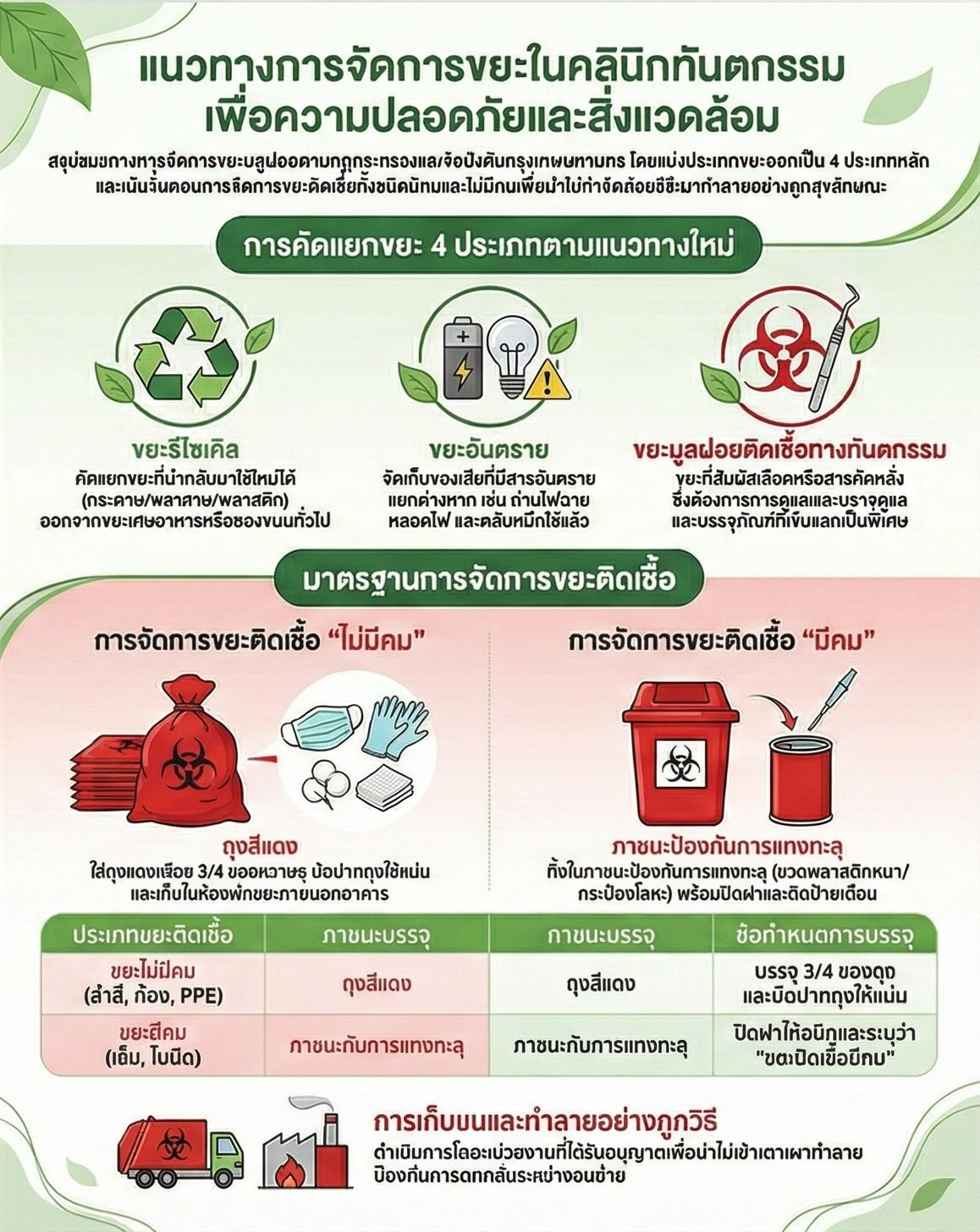
The company's business operations generate waste from dental services. The company manages infectious waste in accordance with the Ministerial Regulation on the Disposal of Infectious Waste B.E. 2545 (2002) of the Ministry of Public Health and the Bangkok Metropolitan Administration Regulations on Waste Management Principles. In 2021, the company reviewed and updated its guidelines for managing dental materials and waste, including consumables from dental treatments such as syringes, cotton, various gauzes, as well as general waste from dental operations, which can be divided into 4 types (according to the new guidelines), comprising:
-
Recyclable Waste is waste that can be sorted for processing and reuse, such as paper, plastic, metal, and rubber.
-
Hazardous Waste is waste that may cause harm or contains hazardous substances, such as used batteries, spray cans containing chemicals, used ink cartridges, light bulbs, etc.
-
General Waste includes general waste, both wet and dry, that does not meet the characteristics of the three aforementioned waste types, such as non-hazardous waste, food scraps, snack wrappers, bags, or food containers, etc.
-
Dental Infectious Waste which can be divided into
-
Non-sharp Waste includes cotton, gauze, personal protective equipment (PPE), etc. Non-sharp infectious waste will be separated into red-bag-lined bins, which are designated as tightly lidded bins. Infectious waste should only fill 3/4 of the bag's volume. The bag opening should be tied securely, and the bag then taken to the infectious waste storage room located outside the building.
-
Sharp Waste includes sharp materials and instruments such as syringes and surgical blades, which must be disposed of in puncture-resistant containers, such as thick plastic bottles or metal cans with tightly sealed lids, and labeled “Sharp Infectious Waste.” Once the sharp waste fills the container, seal the lid tightly and store it in the infectious waste storage room outside the building.
-
Subsequently, local government agencies authorized to dispose of infectious waste from clinics, which are public health service establishments (meaning both public and private hospitals and animal hospitals), manage infectious waste generated by healthcare facilities in Bangkok. The company has contracted Krungthep Thanakom Co., Ltd., which is authorized by local officials to dispose of infectious waste under the supervision of local government, to provide collection and disposal services for infectious waste to healthcare facilities located in the Bangkok metropolitan area. This is for the collection and disposal of infectious waste from the company's branches located in the Bangkok metropolitan area. For branches located in the surrounding provinces, the company has contracted the respective Provincial Administrative Organizations to collect, transport, and dispose of infectious waste. Operators of infectious waste transport vehicles must exercise caution to prevent infectious waste and its containers from falling during transport to the infectious waste disposal site, following proper disposal guidelines, such as incineration.
Waste — Generation, Disposal & Recycling
Waste Generation, Disposal & Recycling
| Metric | Current Year | Previous Year | Two Years Ago |
|---|---|---|---|
| Total waste generated (Kilograms) | 4,519 | 3,590 | 5,490 |
| Non-hazardous waste (Kilograms) | |||
| Non-hazardous waste - Landfilling (Kilograms) | |||
| Non-hazardous waste - Incineration (with energy recovery) (Kilograms) | |||
| Non-hazardous waste - Incineration (without energy recovery) (Kilograms) | |||
| Non-hazardous waste - Other disposal operations (Kilograms) | |||
| Hazardous waste (Kilograms) | 4,519 | 3,590 | 5,490 |
| Hazardous waste - Landfilling (Kilograms) | |||
| Hazardous waste - Incineration (with energy recovery) (Kilograms) | |||
| Hazardous waste - Incineration (without energy recovery) (Kilograms) | |||
| Hazardous waste - Other disposal operations (Kilograms) | 4,519 | 3,590 | 5,490 |
| Total reused/recycled waste (Kilograms) | |||
| Reused/Recycled non-hazardous waste (Kilograms) | |||
| Reused non-hazardous waste (Kilograms) | |||
| Recycled non-hazardous waste (Kilograms) | |||
| Reused/Recycled hazardous waste (Kilograms) | |||
| Reused hazardous waste (Kilograms) | |||
| Recycled hazardous waste (Kilograms) |
Waste — Targets
Has Set Targets
No
Waste — Performance & Outcomes
Has Performance Results
No
GHG — Plan & Guidelines
Has a GHG Management Plan
No
Plan Description
Greenhouse Gas Reduction Management
The company places importance on greenhouse gas reduction management. The company's activities that may impact greenhouse gas emissions are primarily related to energy consumption, such as electricity usage for air conditioning. However, the company is currently in the process of studying detailed approaches and collecting data to establish future targets and guidelines for greenhouse gas reduction. The greenhouse gas emission data has not yet been verified. The company is committed to undergoing verification by verifiers registered with the Thailand Greenhouse Gas Management Organization (Public Organization) or TGO in the future.
GHG — Emissions
GHG Emissions
| Metric | Two Years Ago |
|---|---|
| Total GHG emissions (Metric tonnes of carbon dioxide equivalent) | 0 |
| Total greenhouse gas emissions 1 (Metric tonnes of carbon dioxide equivalent) | |
| Total greenhouse gas emissions 2 (Metric tonnes of carbon dioxide equivalent) | |
| Total greenhouse gas emissions 3 (Metric tonnes of carbon dioxide equivalent) |
GHG — Emissions Verification
Emissions Verified by a Third Party
No
GHG — Principles & Standards
Principles & Standards Applied
| Standard |
|---|
| 2671 |
GHG — Targets
Has Set GHG Targets
No
GHG — Performance & Outcomes
Has Performance Results
No
Environmental Legal Incidents
Legal Violation Incidents
| Metric | Current Year | Previous Year | Two Years Ago |
|---|---|---|---|
| Number of cases or incidents of legal violations or negative environmental impact (cases) | 0 | 0 | 0 |
Other Environmental Management
Plan Description
Innovative Air Circulation System “LDC Next Normal Air Change” for Dental Clinics
Following the COVID-19 pandemic, as well as air pollution situations such as fine particulate matter PM2.5, which can penetrate the respiratory system and bloodstream, affecting health in both the short and long term, service recipients and dental personnel have become concerned about the risk of infection and service safety, especially in treatment procedures that generate airborne aerosols within enclosed spaces.
As a dental center service provider, the Company prioritizes elevating air quality standards within its clinics. In collaboration with Saijo Denki, an expert in air conditioning systems, the Company has designed and developed the innovative air circulation system “LDC Next Normal Air Change,” specifically tailored for dental clinics to create an environment with cleanliness and safety levels comparable to operating rooms.
The system operates by continuously drawing 100% fresh air from outside, subjecting it to a quality improvement process before supplying it to the dental rooms. This replaces contaminated indoor air and creates a clean air flow throughout the operational area, without recirculating old air. Furthermore, exhaust air undergoes treatment before being discharged outside to prevent environmental impact.
In terms of efficiency, the system boasts an Air Change per Hour (ACH) rate of up to 24 cycles per hour, approximately twice the standard for general dental rooms, and aligns with the Guidelines for Environmental Infection Control in Health-Care Facilities (CDC, 2003). It can eliminate up to 99% of airborne pathogens within 23 minutes, significantly reducing the chance of pathogen dispersion in a short period, resulting in 99.99% safety from viral infections.
Note 1 Tested and certified by Japan Spinners Inspecting Foundation
2 Tested by Japan Electrical Testing Laboratories (JET), Japan, and King Mongkut's University of Technology Thonburi
By integrating these technologies, the “LDC Next Normal Air Change” system can elevate air quality within dental clinics, reduce infection risks, and enhance patient confidence, under the concept of “Unchanging Safety,” which reflects the Company's commitment to continuous and sustainable development of service standards.
Air Quality under the innovative air circulation system “LDC Next Normal Air Change”
Good indoor air quality under the innovative air circulation system “LDC Next Normal Air Change” results from the systematic design and development of a system focused on controlling key air quality factors, in compliance with hygiene principles and international standards. Its important components can be described as follows:
-
Air Change per Hour (ACH) The system is designed for air exchange at an appropriate air change rate, utilizing the principle of continuously introducing fresh air to replace stale air inside the room. An air change rate of 24 ACH can reduce airborne pollutants and pathogens by up to 99% within approximately 12 minutes, significantly reducing the risk of pathogen spread.
-
Relative Humidity Control The system controls relative humidity to be within 40–60%, which is an optimal level for human well-being (Comfort Zone) and helps inhibit the growth of mold and bacteria, as excessively high humidity levels promote microbial proliferation.
-
Control of Fine Particulate Matter (PM0.1 and PM2.5) The system prioritizes the control of fine particulate matter, which can infiltrate buildings from the external environment. Such particulate matter is classified as a human carcinogen by the World Health Organization (thus, air quality control is implemented along with setting safety values for substances used in the system, such as controlling ozone levels not exceeding 0.05 parts per million to prevent health impacts).
-
Carbon Dioxide (CO 2 ) A system to control the concentration of carbon dioxide gas, which is generated by the breathing of building occupants, to a level not exceeding 1,000 parts per million (in accordance with ASHRAE and SHA guidelines) to maintain fresh air quality and reduce health impacts and work performance.
-
Dust Mite Control and Elimination Continuous control of relative humidity creates an unsuitable environment for the survival of dust mites and microorganisms. Maintaining appropriate humidity levels causes dust mites to lose water and die within approximately 11 days, supported by test results from medical research institutions.
Employees — Plan & Guidelines
Has an Employee Management Plan
Yes
Plan Description
Compensation Payment
The company has a compensation management policy as a tool to retain and attract talented personnel, considering their past work experience. Additionally, special cash compensation is considered, with various awards given to employees who achieve performance targets set by the company. These include specialized skill allowances and various types of dental sales awards. These awards are designed to incentivize employees to enhance their work potential, with different criteria for payment.
Employee Training and Development
The company primarily focuses on developing employees' work potential and enhancing their knowledge through internal training programs, benefiting their current and future performance. The company develops internal courses accessible online to meet current operational needs, allowing employees to learn independently as appropriate. In 2025, the company primarily sent employees for external training without charge, resulting in no training expenses this year. Concurrently, employees are encouraged to receive more training from the Thantawat Institute, with an emphasis on upskilling and fostering employees' understanding of the organizational culture through regular online meetings to align with and drive the company's strategies. This also includes continuously and sustainably emphasizing anti-corruption in all forms to employees, leading to a 113.94% increase in employee training hours.
Employee Engagement
Therefore, the company provides a platform for employees to express themselves freely. Company executives regularly visit all levels of employees to give them opportunities to express their opinions openly and directly, fostering a culture of daring to think and act correctly for the common good. The company recognizes that Thai society is a diverse society where people of different races, religions, and ethnicities can coexist peacefully and unitedly without division, embracing diversity and a spirit of mutual support. Consequently, there are no human rights violations regarding class or ethnic discrimination. All employees have equal rights in accordance with the guidelines.
Child Labor
The company has a clearly defined employment policy that prohibits the use of child labor.
Occupational Safety and Health
The company provides training for new employees joining the company, emphasizing safety in serving customers, understanding operating procedures, and exercising caution when using various equipment and tools to prevent workplace accidents. Employees must collectively monitor equipment to prevent short-term and long-term damage, which also reduces internal workplace accidents. The company disseminates information to employees through various channels, emphasizing that branch managers conduct team meetings to ensure employees understand safety, occupational health, and working environment policies. This also includes inspecting the working environment and checking the readiness of materials and equipment for emergencies, such as inspecting fire extinguishers, emergency lights, and emergency signals, along with contingency plans.
The company's report on injury statistics, occupational diseases, and the number of employee fatalities due to work in 2025 indicates that only 1 employee sustained minor work-related injuries, with no employees suffering severe injuries or fatalities due to work, and no rates of absenteeism or illness resulting from work. Furthermore, the company continuously promotes good health among employees. The company offers an annual health check-up program for employees at hospitals where they utilize their social security benefits. The company supports employees in undergoing health check-ups beyond what is mandated by social security, including vaccinations at 1,500 Baht per person per year, and supports a lunch program for employees, where employees can choose appropriate meals for their branch. The company prioritizes safety in service delivery to ensure the highest level of safety for both service providers and recipients. Therefore, it focuses on acquiring modern and safe equipment and preventive measures, and educates employees on how to prevent and protect themselves safely while on duty.
Plan Areas
| Plan Area |
|---|
| Fair employee compensation |
| Employee training and development |
| Promoting employee relations and participation |
| Child labor |
| Occupational health and safety in workplace |
Employees — Workforce
Workforce Data
| Metric | Current Year | Previous Year | Two Years Ago |
|---|---|---|---|
| Total number of employees (Persons) | 196 | 225 | 257 |
| Number of male employees (Persons) | 13 | 21 | 24 |
| Number of female employees (Persons) | 183 | 204 | 233 |
| Total employment of disabled persons (people) | 2 | 3 | 3 |
| Total disabled employees (people) | 2 | 3 | 3 |
| Total male disabled employees (people) | 0 | 1 | 1 |
| Total female disabled employees (people) | 2 | 2 | 2 |
| Total disabled workers who are non-employee (people) | 0 | 0 | 0 |
| Contributions to the fund for promoting and improving the quality of life for disabled persons | 0 | 0 | 0 |
| Total number of male employees in operational level (Persons) | 9 | 16 | 21 |
| Total number of male employees in management level (Persons) | 3 | 4 | 2 |
| Total number of male employees in executive level (Persons) | 1 | 1 | 1 |
| Total number of female employees in operational level (Persons) | 159 | 184 | 213 |
| Total number of female employees in management level (Persons) | 21 | 17 | 17 |
| Total number of female employees in executive level (Persons) | 3 | 3 | 3 |
Employees — Remuneration & Provident Fund
Remuneration & Provident Fund
| Metric | Current Year | Previous Year | Two Years Ago |
|---|---|---|---|
| Total disabled employees (people) | 77,206,796 | 80,342,041 | 89,446,816 |
| Total male employee remuneration (Baht) | 11,340,015 | 11,693,459 | 13,575,749 |
| Total female employee remuneration (Baht) | 65,866,781 | 68,648,582 | 75,871,067 |
| Number of employees eligible to participate in PVD (persons) | 196 | 225 | 257 |
| Total number of employees joining employee provident fund (Persons) | 79 | 104 | 140 |
| Percentage of total number of employees joining employee provident fund to total number of employees (%) | 40.31 | 46.22 | 54.47 |
| Number of PVD members / Total eligible employees (%) | 40.31 | 46.22 | 54.47 |
| Total amount of provident fund contributed by the Company (Baht) | 611,204 | 671,035 | 880,862 |
| Total amount of provident fund contributed by employee (baht) |
Employees — Training & Development
Training Data
| Metric | Current Year | Previous Year | Two Years Ago |
|---|---|---|---|
| Average employee training hours (Hours / Person / Year) | 35.21 | 16.46 | 3.87 |
| Employee development and training expenses (baht) | 0 | 0 | 34,216 |
Employees — Occupational Health & Safety
Occupational Health & Safety Data
| Metric | Current Year | Previous Year | Two Years Ago |
|---|---|---|---|
| Total number of lost time injury incidents by employees (Cases) | 1 | 1 | 1 |
Employees — Labour Relations
Labour Relations Data
| Metric | Current Year | Previous Year | Two Years Ago |
|---|---|---|---|
| Total voluntary resignations (Persons) | 33 | 63 | 65 |
| Male employees who voluntary resigned (Persons) | 1 | 4 | 7 |
| Female employees who voluntary resigned (Persons) | 32 | 59 | 58 |
| Percentage of employee turnover leaving the Company voluntarily (%) | 16.84 | 28 | 25.29 |
| Evaluation result of employee engagement | 1 |
Employees — Employee Representation
Employees Are Represented Collectively
No
Employees — Targets
Has Set Employee Targets
No
Employees — Performance & Outcomes
Has Performance Results
No
Customers — Plan & Guidelines
Has a Customer Management Plan
Yes
Plan Description
Providing Services with Responsibility Towards Customers
LDC is one of the first dental clinics to offer tangible treatment guarantees, providing dental warranty certificates for certain treatments such as scaling, fillings, crowns, and dentures, to build confidence among service recipients. This also helps maintain good relationships with service recipients. The company will widely publicize this information to service recipients. In its business operations to date, the company has never been sued by service recipients due to its care system and commitment to not abandoning service recipients.
Building Good Relationships with Service Recipients
Focuses on providing service with a recipient-centric approach, ensuring preparedness before service by obtaining understanding prior to service (Consent Form). After treatment, there will be a follow-up to inquire about post-treatment issues via telephone.
Enhancing Customer Satisfaction and Strengthening Customer Relationships
The company has a policy for managing feedback and complaints through various channels, such as directly at branches, via Call Center, and through various social media platforms, to allow service recipients to provide suggestions or lodge complaints if treatment outcomes do not meet expectations. The company will respond to such complaints immediately. By evaluating treatment outcomes through surveys and assessing service satisfaction, the company will use the collected data to review and improve its services. The company operates under the philosophy that service recipients are like respected elders, leading to a more personalized service approach. Therefore, the service model has been adjusted from the traditional setup where staff answered questions behind a counter and dentists had limited time with service recipients. Now, more staff are assigned to care for and engage with service recipients, enabling them to better understand the needs and concerns of service recipients, thereby responding to their needs and addressing their anxieties more effectively.
Protection of Customer Personal Data
The company prioritizes the security and privacy of customer data by collecting and using personal information only as necessary for dental services, follow-up, and continuous appointments. The company will not disclose information to third parties unless consent is obtained or required by legal provisions. Customer data will be stored securely and deleted 10 years after the termination of services. Customers can also seek consultation from other doctors and set conditions regarding privacy in treatment. Furthermore, the company may use social media platforms such as LINE to send medical information securely and quickly, and customers can voluntarily choose to receive or decline news, special privileges, and promotions from the company.
The company operates under Personal Data Protection Act B.E. 2562 (2019) and is ready to provide additional information through customer service.
Plan Areas
| Plan Area |
|---|
| Responsible production and services for customers |
| Communication of product and service impacts to customers/consumers |
| Development of customer satisfaction and customer relationship |
| Protection of customer personal information |
Customers — Satisfaction Results
Customer Satisfaction Results
| Metric |
|---|
| Evaluation results of customer satisfaction |
Customers — Targets
Has Set Customer Targets
No
Customers — Performance & Outcomes
Has Performance Results
No
Community & Social — Plan & Guidelines
Has a Community & Social Plan
Yes
Plan Description
The company has continuously recognized the importance of social responsibility and believes that for long-term sustainable growth, businesses must prioritize good governance. This includes considering the impact on society, the environment, and stakeholders both within and outside the organization, in line with sustainable development guidelines. It also considers the participation of all stakeholder groups, in accordance with its policy and commitment to ensuring good dental health for people, leading to a better life and a better society, through effective community assistance and development. The company establishes policies and initiates various projects that emphasize oral and dental health care, the quality of life for people, communities, society, and the environment. This is because it believes that social responsibility enables businesses to grow stably and truly sustainably. As one of the company's missions is to "create business value along with social value," it has a social management plan.
• Providing smiles to the community and independent seniors annually.
• Granting scholarships and supporting various foundations.
• Organizing an Open House project for students interested in becoming dentists to broaden their perspectives.
Based on the aforementioned policy, the company continuously and consistently implements various projects and activities related to social responsibility, assisting and developing communities.
Plan Areas
| Plan Area |
|---|
| Employment and professional skill development |
| Education |
| Disadvantaged and vulnerable groups |
Community & Social — Targets
Has Set Community & Social Targets
No
Community & Social — Performance & Outcomes
Has Performance Results
Yes
Performance Description
Small Brushes for Healthy Teeth Project
The company organized a campaign “Small Brushes for Healthy Teeth” to collect new toothbrushes and deliver them to underprivileged children in remote communities, as part of supporting and fostering strong dental health. It aims to instill awareness and encourage children's attention to dental care. The project was launched on October 21, 2567 (2024), which is National Dental Public Health Day and the birthday of Her Royal Highness Princess Srinagarindra, the Mother of Thai Dental Public Health. This campaign, filled with warmth and smiles, has created a lasting impression and conveyed the power of happiness to children in remote areas, continuing impressively to the present.
Throughout the project, LDC Dental received excellent responses from donors and partners who supported this initiative. This toothbrush donation is not merely a gift of items but an offering of opportunities for oral health care, helping children achieve brighter smiles and greater confidence. These small toothbrushes have become a symbol of care and goodwill that many have extended to children in underprivileged communities. The band Paper Planes warmly supported the project activities, creating happiness and encouraging more people to participate in helping children. The atmosphere was filled with appreciation from both attendees and the entire LDC team.
In addition to donating toothbrushes to promote children's oral health, this campaign also raised awareness about dental care and the importance of access to oral hygiene tools in underserved communities. This success was not achieved by the team alone but resulted from the cooperation and generosity of all sectors, including donors, medical personnel, partner foundations, and everyone involved in the project. The company is deeply grateful for all the kindness that contributed to this mission, as every support not only creates new smiles for children but also has a long-term impact on their health and quality of life. This inspires the company to continue implementing such beneficial projects annually. The company hopes this project will be the starting point for small changes that will grow into a bright future for all children.
Open House Project
LDC Dental Open House Project: Opening Doors to Dreams, Shaping the Future of Dentists
The company recognizes the importance of developing qualified medical personnel to meet the country's public health needs, and has therefore initiated the project "LDC Dental Open House" continuously and consistently for over 10 years, with the primary objective of providing opportunities for students interested in the dental profession to gain real-world work experience, learn about modern dental technology innovations, and hear insights from expert dentists, thereby inspiring and preparing them for future careers in the profession.
This project emphasizes practical learning and career guidance, comprising the following main activities:
-
Experience Sharing: Discussion activities and sharing of real-world work experiences from various dental specialists to provide a comprehensive view of diverse work and professional ethics.
-
Clinic Tour & Innovation Showcase: Visits to clinics and laboratories to learn about safety standards and digital dentistry tools.
-
Future Perspective: Providing advice on preparing for entrance examinations for further study, as well as trends and directions of the international dental industry.
Outcomes and Value Creation for Society The Open House project not only provides knowledge to youth but also fosters social responsibility in the dimensions of education and labor, as follows:
-
Youth Aspect:
-
Professional Aspect: It promotes a positive image of the dental profession and instills a sense of responsible service to patients from the student level.
-
Sustainability Aspect: It establishes a network of relationships between the company and educational institutions and communities, which is a crucial foundation for continuously developing qualified personnel for the public health system.
Furthermore, this project is considered part of the human rights policy regarding "providing educational opportunities and youth development."
Law Violation Incidents
Law Violation Incidents
| Metric | Current Year | Previous Year | Two Years Ago |
|---|---|---|---|
| The total number of cases or incidents of significant violations of laws or regulations regarding social and human rights (Cases) | 0 | 0 | 0 |
| The total number of cases or incidents that cause significant labor disputes (Cases) | 0 | 0 | 0 |
| The total number of cases or complaints related to consumer rights violations (Cases) | 0 | 0 | 0 |
| The total number of cases or complaints related to partner rights violations (Cases) | 0 | 0 | 0 |
| The total number of cases or incidents that cause disputes with the community/society (Cases) | 0 | 0 | 0 |
| The total number of cases or incidents related to cyber security or customer data breaches (Cases) | 0 | 0 | 0 |
| The total number of cases or incidents related to safety and occupational health at work (Cases) | 0 | 0 | 0 |